
Data has become an important part of how modern businesses make decisions. Companies across industries use data to understand customers, improve operations, measure performance, identify opportunities, and solve business problems. As a result, professionals with practical data analytics skills are increasingly valuable in the technology and business sectors. For students, graduates, and working professionals in Maharashtra, learning data analytics can be a practical way to develop technology and analytical skills. A well-structured Data Analytics Course in Maharashtra can help learners understand how to collect, clean, analyze, visualize, and interpret data for real-world decision-making.
Whether you are from an IT background, commerce, science, engineering, or another field, the right training can help you develop a foundation for data-focused career opportunities.
What Is Data Analytics?
Data analytics is the process of examining data to discover useful patterns, trends, relationships, and insights. Businesses use these insights to make informed decisions instead of relying only on assumptions.
A data analytics professional may work with large datasets, identify important information, prepare reports, create dashboards, and communicate findings to business teams.
For example, an e-commerce company can analyze sales data to determine which products perform best. A marketing team can study customer behavior to understand which campaigns generate better engagement. Similarly, a manufacturing company can analyze operational data to identify inefficiencies.
This makes data analytics relevant across many industries.
Why Learn Data Analytics in Maharashtra?
Maharashtra has a strong presence across technology, finance, manufacturing, healthcare, retail, education, e-commerce, and other sectors. Cities such as Pune, Mumbai, Nagpur, Nashik, and Chhatrapati Sambhajinagar offer educational and professional opportunities for people interested in technology and analytics.
Learning data analytics can help students develop skills that are applicable across different industries rather than limiting them to one specific business sector.
A Data Analytics Course in Maharashtra can be particularly useful for learners who want to:
- Develop practical analytical skills
- Understand business data
- Learn popular analytics tools
- Improve their problem-solving abilities
- Build data-driven projects
- Prepare for data-related career opportunities
- Transition toward a technology-oriented career
What Do You Learn in a Data Analytics Course?
A good analytics program should provide a combination of fundamental concepts, tools, and practical application. The exact curriculum may vary between institutes, but learners generally benefit from understanding the following areas.
1. Excel for Data Analysis
Excel remains a useful tool for organizing, analyzing, and presenting data. Beginners can learn formulas, functions, pivot tables, charts, data cleaning techniques, and other features used for analysis.
Learning Excel can provide a comfortable starting point for students who are completely new to data analytics.
2. SQL and Database Concepts
SQL is an important skill for working with structured data stored in databases. Learners can understand how to retrieve, filter, sort, combine, and analyze information using SQL queries.
Strong SQL fundamentals can be useful for professionals working with business databases and reporting systems.
3. Data Visualization
Numbers are easier to understand when they are presented visually. Data visualization involves converting information into charts, graphs, and dashboards that communicate insights clearly.
Learners may explore visualization platforms and techniques for creating interactive reports and business dashboards.
4. Statistics for Data Analytics
Basic statistics helps analysts understand data more effectively. Concepts such as averages, percentages, distributions, correlations, and trends can support better interpretation of datasets.
You do not necessarily need to be an advanced mathematician to begin learning analytics, but a good understanding of fundamental statistics can be valuable.
5. Python for Data Analytics
Python is widely used in the technology and data ecosystem. Learners interested in developing more advanced analytical skills can learn Python fundamentals and libraries used for data manipulation and analysis.
Python can also help automate repetitive tasks and support more complex data workflows.
Who Can Join a Data Analytics Course?
One of the advantages of data analytics is that it can be relevant to learners from different academic backgrounds.
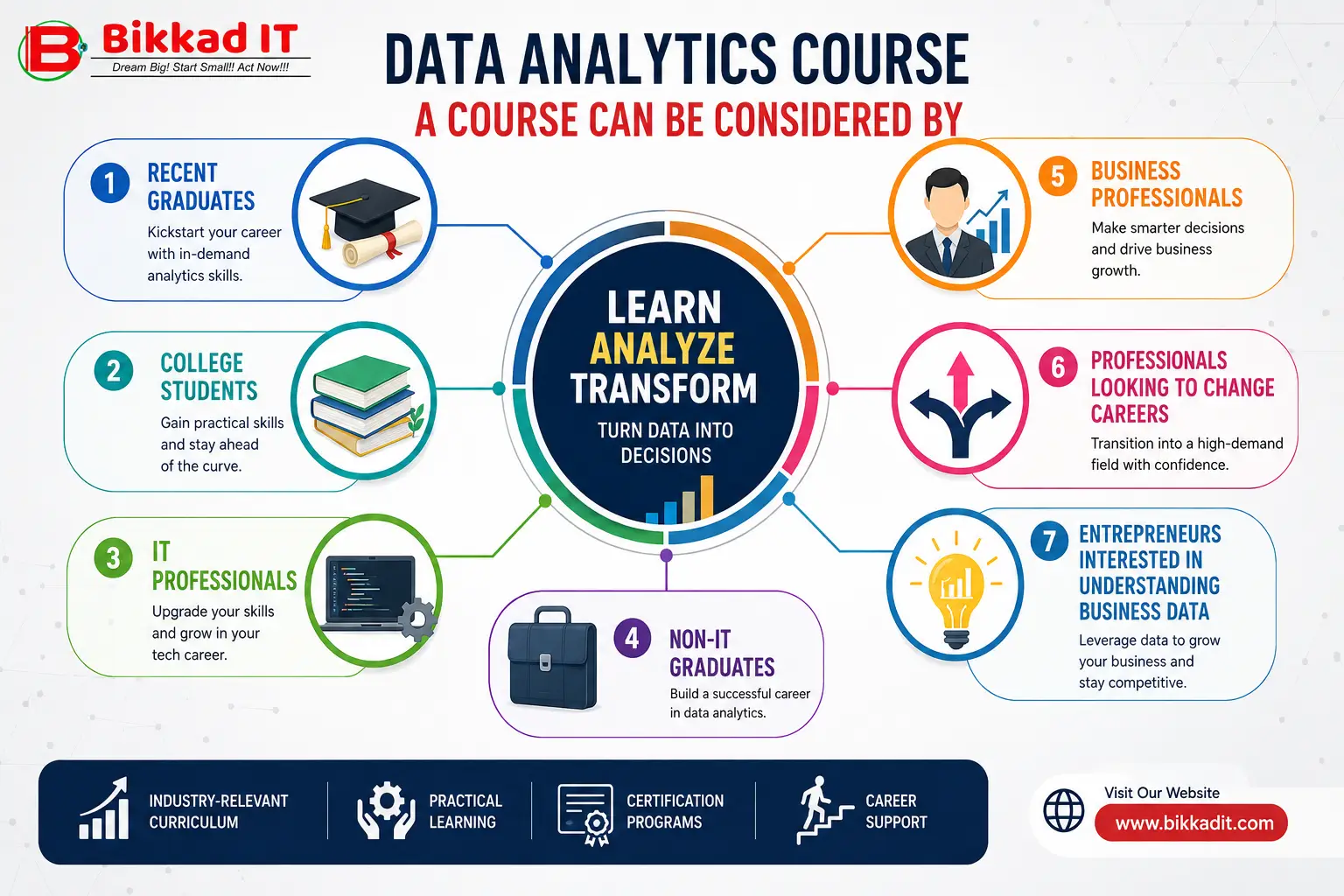
A course can be considered by:
However, learners should choose a program according to their existing knowledge and career objectives.
For complete beginners, starting with basic concepts before moving into advanced tools can make the learning process easier.
What Skills Should a Data Analyst Have?
Learning software tools is only one part of becoming a capable data analyst. Employers and businesses also value analytical thinking and communication.
Important skills include:
Analytical thinking: The ability to examine information and identify meaningful patterns.
Problem-solving: Understanding a business problem and determining what data can help address it.
Data interpretation: Converting raw information into useful conclusions.
Communication: Explaining analytical findings in a simple and understandable way.
Attention to detail: Identifying inconsistencies, missing information, and errors in datasets.
Business understanding: Connecting data insights with real business objectives.
Developing these skills alongside technical knowledge can make the learning experience more practical.
What Career Opportunities Are Available After Data Analytics Training?
Data analytics skills can be applied across numerous industries. Depending on your education, experience, technical abilities, and career goals, possible roles may include:
- Data Analyst
- Business Analyst
- Reporting Analyst
- Business Intelligence Analyst
- Marketing Analyst
- Operations Analyst
- Junior Data Professional
Job responsibilities can differ significantly between organizations. Therefore, students should research individual job descriptions and understand the skills expected for their target roles.
How to Choose the Right Data Analytics Course in Maharashtra?
With different training options available, choosing the right program requires careful consideration.
Check the Curriculum
Make sure the course covers relevant fundamentals and tools rather than focusing only on theory.
Look for Practical Learning
Projects, assignments, datasets, and hands-on exercises can help learners understand how analytical concepts are applied in practical situations.
Consider the Learning Format
Depending on your schedule, you may prefer classroom-based, online, or hybrid learning. Choose an approach that allows you to practice consistently.
Review the Training Approach
Look for structured learning that progresses from fundamentals to more advanced concepts. Beginners should have enough support to understand technical topics step by step.
Focus on Skills, Not Just Certificates
A certificate can document course completion, but practical skills and the ability to demonstrate your knowledge through projects are more important when building a career.
Can Non-IT Students Learn Data Analytics?
Yes. Students from non-IT backgrounds can learn data analytics if they are willing to develop the necessary technical and analytical skills.
For beginners, the most effective approach is usually to start with basic data concepts, spreadsheets, statistics, and SQL before progressing to more advanced tools.
A learner from commerce or business, for example, may already have an understanding of numbers and business concepts. An engineering graduate may have stronger technical fundamentals. Each background can provide a different starting advantage.
How to Build a Data Analytics Portfolio?
A portfolio can help demonstrate what you have learned. Instead of simply listing tools on a resume, create projects that show how you used those tools to solve a problem.
For example, you could create projects based on:
- Sales performance
- Customer behavior
- E-commerce data
- Employee information
- Marketing campaigns
- Business operations
For each project, explain the objective, data source, cleaning process, analysis, visualizations, and key findings. This gives potential employers a clearer understanding of your practical abilities.
Frequently Asked Questions
Is data analytics a good career option in Maharashtra?
Data analytics is applicable across technology, finance, healthcare, manufacturing, retail, marketing, and other sectors. Learners who develop strong analytical and technical skills can explore a variety of career paths.
What should I learn first in data analytics?
Beginners can start with spreadsheet fundamentals, basic statistics, SQL, data visualization, and then progress toward Python and other advanced technologies.
Can freshers learn data analytics?
Yes. Freshers can begin with foundational concepts and gradually develop their skills through regular practice and practical projects.
Is Python necessary for data analytics?
Python is a valuable skill for many data-related roles, particularly when working with larger datasets, automation, and advanced analysis. However, the tools required can vary depending on the job role.
How long does it take to learn data analytics?
The learning period depends on your existing knowledge, course structure, practice schedule, and career goals. Consistent hands-on practice is important for developing confidence.
Start Your Data Analytics Learning Journey
Data analytics is more than learning a collection of software tools. It involves understanding data, asking the right questions, identifying meaningful patterns, and communicating insights that can support better decisions.
If you are searching for a Data Analytics Course in Maharashtra, focus on a program that combines technical concepts with practical learning. Building skills in Excel, SQL, visualization, statistics, and Python can give you a strong foundation for exploring data-focused career opportunities.
For students and professionals looking to develop practical technology skills, Bikkadit offers learning opportunities designed to help learners strengthen their technical foundation and prepare for the changing IT industry. A focused approach to learning, regular practice, and project-based experience can help you move from understanding data concepts to applying them in real-world situations.

