
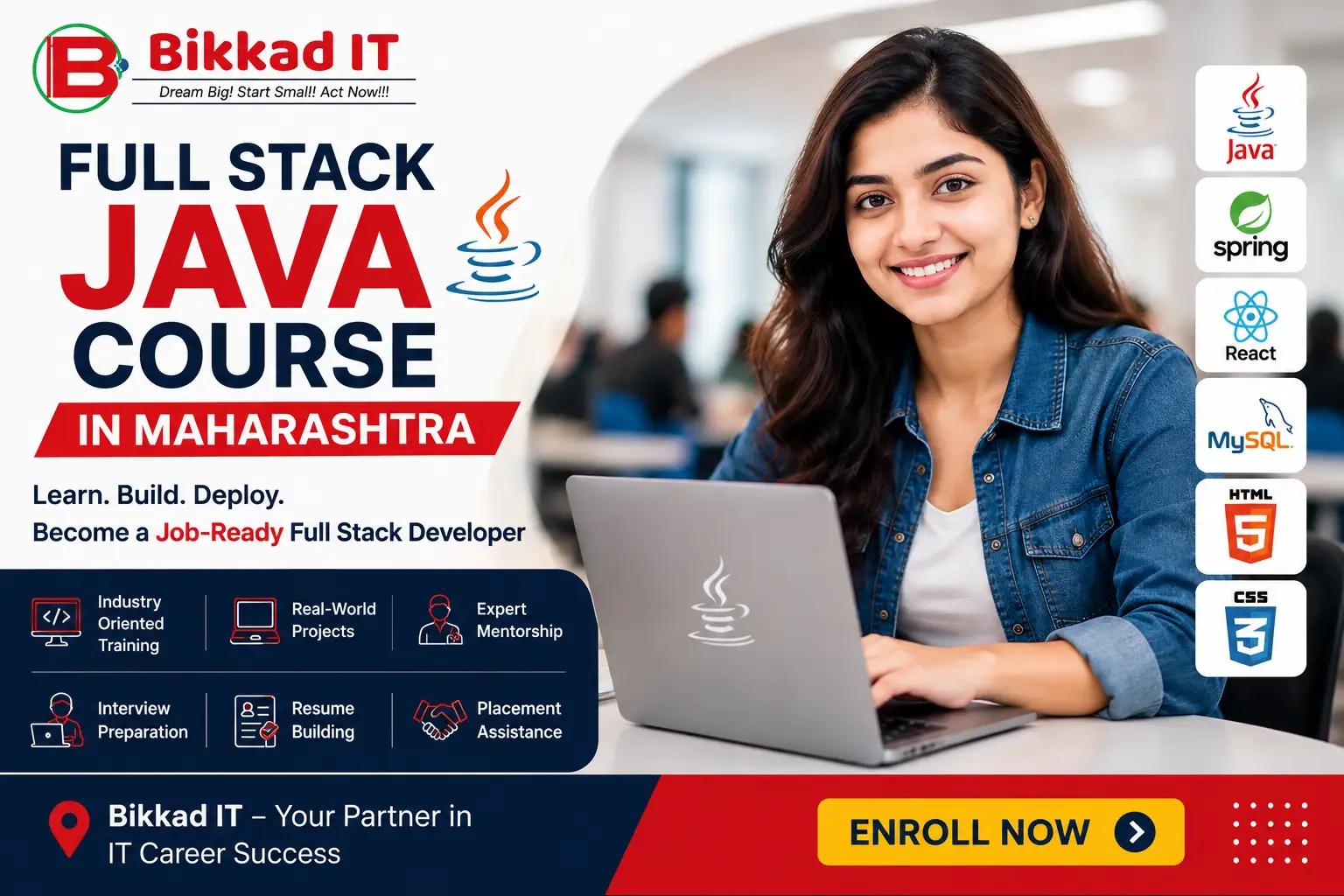
The software development industry continues to create opportunities for professionals who have practical knowledge of modern programming technologies. Among the different development paths available today, Full Stack Java Development is a popular choice for learners who want to understand both frontend and backend development. A good Full Stack Java Course in Maharashtra should go beyond teaching programming syntax. Students need to understand how a complete web application works, including the user interface, server-side programming, databases, APIs, testing, and deployment.
Bikkadit provides structured IT training designed to help students, freshers, and working professionals develop practical software development skills. Its Java Full Stack program covers important technologies such as Core Java, SQL, JDBC, Hibernate, Spring Boot, REST APIs, React, microservices, and project development.
Also Read: Data Analytics Course in Maharashtra
What Is Java Full Stack Development?
Java Full Stack Development refers to the development of complete web applications using Java-based backend technologies along with modern frontend technologies.
A Full Stack Developer generally works across different layers of an application. The frontend is responsible for what users see and interact with, while the backend handles business logic, data processing, authentication, APIs, and communication with databases.
A Java Full Stack Developer may work with technologies such as:
- Core Java and Advanced Java
- HTML and CSS
- JavaScript
- React
- SQL and databases
- JDBC
- Hibernate
- Spring Framework
- Spring Boot
- REST APIs
- Microservices
- Git and development tools
Learning these technologies together helps students understand how different components of a software application communicate with one another.
Why Learn Full Stack Java Development?
Java has been widely used for developing enterprise applications, web applications, backend systems, and business software. Its ecosystem also provides developers with frameworks and tools for building scalable applications.
Learning full-stack development can be useful because it gives learners a broader understanding of the software development process.
Instead of focusing only on backend programming, students can learn how to:
- Build responsive web interfaces
- Develop backend applications
- Connect applications with databases
- Create and consume APIs
- Implement business logic
- Work with frameworks
- Develop complete projects
- Understand application deployment
This broader skill set can be valuable for students preparing for software development roles.
Why Choose a Full Stack Java Course in Maharashtra?
Maharashtra has a strong presence in the technology and education sector, with cities such as Pune, Mumbai, Nashik, Nagpur, and other growing IT hubs offering opportunities for technology professionals.
For students and professionals in the state, learning through a structured training program can make the journey from programming basics to application development more organized.
When selecting a training program, learners should look beyond the course title. A useful program should include programming fundamentals, frontend development, backend technologies, databases, practical projects, and career preparation.
What Will You Learn at Bikkadit?
Bikkadit’s Java Full Stack curriculum is designed around several important areas of modern application development.
Core Java Fundamentals
Java programming forms the foundation of the course. Students can develop an understanding of:
- Variables and data types
- Operators and control statements
- Methods and arrays
- Object-oriented programming
- Classes and objects
- Inheritance
- Polymorphism
- Abstraction
- Exception handling
- Collections
- Multithreading
- Java 8 concepts
Strong Java fundamentals are important because advanced frameworks rely heavily on core programming concepts.
SQL and Database Concepts
Most applications need databases to store and retrieve information. Therefore, database knowledge is an important part of full-stack development.
Students learn concepts such as:
- SQL queries
- Joins
- Constraints
- Primary and foreign keys
- Database relationships
- Views
- Indexes
- Functions
- Stored procedures
- Database design
Practical database knowledge allows developers to work with application data more effectively.
JDBC and Hibernate
JDBC provides a way for Java applications to communicate with databases. Hibernate, on the other hand, simplifies database interaction through object-relational mapping.
Learning these technologies helps students understand how backend applications communicate with and manage database information.
Spring Boot for Backend Development
Spring Boot has become an important technology in modern Java development. It simplifies the process of creating production-ready Java applications.
Students can learn concepts related to:
- Spring Core
- Dependency Injection
- Inversion of Control
- Spring Boot
- REST API development
- Spring Data JPA
- CRUD operations
- Exception handling
- Database integration
These concepts help learners understand how Java-based backend applications are structured.
Frontend Development with React
Full Stack Development is not limited to backend programming. Developers also need to understand how users interact with applications.
The frontend portion of training can include:
- HTML5
- CSS3
- JavaScript
- Responsive design
- DOM concepts
- Modern JavaScript
- ReactJS
- Components
- Props and State
- Hooks
- Routing
- API integration
React allows developers to create interactive user interfaces and connect them with backend APIs.
REST APIs and Microservices
Modern applications frequently use APIs to allow different software components to communicate with each other.
Students can learn how REST APIs work and how frontend applications communicate with backend services. They can also gain an introduction to microservices architecture and understand how large applications can be divided into smaller, manageable services.
These concepts are particularly useful for learners who want to understand modern application architecture.
Importance of Practical Project Training
One of the biggest differences between simply studying programming and learning software development is practical implementation.
A student may understand Java syntax but still struggle to build a complete application without hands-on practice.
Project-based learning helps students apply concepts in a practical environment. During training, learners can work with different components such as:
Frontend → API → Backend → Database
This gives them an opportunity to understand how a complete application functions.
Projects can also help learners improve:
- Problem-solving skills
- Debugging abilities
- Coding practices
- Database handling
- API integration
- Application development skills
- Confidence during technical interviews
Building projects can also give candidates practical work to discuss when attending interviews.
Why Choose Bikkadit for Java Full Stack Training?
Selecting the right Java full-stack training institute in Maharashtra is an important decision, particularly for beginners.
Bikkadit focuses on practical and industry-oriented IT training. Its Java Full Stack program combines programming fundamentals with frontend, backend, database, API, framework, and project-based learning.
Students can benefit from areas such as:
- Structured technical training
- Practical coding sessions
- Industry-relevant technologies
- Project development
- Interview preparation
- Resume support
- Career guidance
- Placement assistance
The objective is to help learners build skills that can be applied beyond the classroom.
Who Can Join Java Full Stack Training?
Java Full Stack training can be considered by different types of learners, including:
- College students
- Recent graduates
- Freshers
- IT graduates
- Professionals looking to improve their development skills
- Working professionals planning a career transition
- Beginners interested in software development
Prior programming experience can be helpful, but beginners can start by learning Java fundamentals and gradually move toward advanced concepts.
Career Opportunities After Full Stack Java Training
After developing strong programming knowledge and practical project experience, learners can explore several software development roles.
Potential career paths include:
- Java Developer
- Full Stack Developer
- Backend Developer
- Software Developer
- Software Engineer
- Web Application Developer
Career outcomes depend on individual skills, project experience, communication abilities, interview performance, and the requirements of employers.
Therefore, students should focus not only on completing a course but also on continuously improving their coding and problem-solving abilities.
How to Select the Right Java Full Stack Training Program
Before enrolling, compare different programs based on their curriculum and learning approach.
Consider whether the course provides:
- Strong Java fundamentals
- Frontend development training
- Database and SQL concepts
- Spring Boot and backend development
- REST API development
- Practical projects
- Modern development tools
- Interview preparation
- Resume and career support
- Placement assistance
A program that combines these elements can provide a more complete learning experience than a course focused only on theoretical concepts.
Start Your Full Stack Development Journey with Bikkadit
Learning full-stack development requires consistency, practice, and a clear understanding of programming fundamentals. Java provides a strong foundation for backend development, while technologies such as React, SQL, Spring Boot, REST APIs, and microservices help learners understand modern application development.
If you are searching for a Java Full Stack Developer Course in Maharashtra, Bikkadit offers a structured learning path covering the major areas required for full-stack application development.
The goal should not simply be to learn multiple technologies. It should be to understand how these technologies work together and use them to build practical applications.
For students, freshers, and working professionals looking to develop software development skills, a well-structured Full Stack Java Training Course Maharashtra can be a useful step toward building a career in the IT industry.
Choose a learning program that provides practical exposure, experienced guidance, project work, and career preparation—and start building your skills one technology at a time.
Frequently Asked Questions
1. What is a Full Stack Java course?
A Full Stack Java course teaches learners how to develop both frontend and backend parts of web applications. It generally covers Java, databases, frontend technologies, backend frameworks, APIs, and project development.
2. Who can join Java Full Stack training?
College students, graduates, freshers, working professionals, and individuals interested in software development can join Java Full Stack training. Beginners can start with programming fundamentals and gradually progress to advanced technologies.
3. Which technologies are important for a Java Full Stack Developer?
Important technologies can include Core Java, SQL, JDBC, Hibernate, Spring Boot, REST APIs, HTML, CSS, JavaScript, React, Git, and microservices.
4. Is Java Full Stack Development suitable for freshers?
Yes. Freshers can consider Java Full Stack Development as a career path if they are interested in programming and are willing to develop strong coding and problem-solving skills. Practical projects and interview preparation can further help them prepare for entry-level opportunities.
5. Why choose Bikkadit for Java Full Stack training?
Bikkadit provides structured IT training focused on practical learning, modern technologies, project development, interview preparation, career guidance, and placement assistance.
6. What career opportunities are available after Java Full Stack training?
Depending on their skills and experience, learners can explore roles such as Java Developer, Full Stack Developer, Backend Developer, Software Developer, Software Engineer, and Web Application Developer.

