
Every modern organization depends on data to understand customers, monitor operations, improve products, and make better business decisions. However, before data can be analyzed or used for artificial intelligence and machine learning, it needs to be collected, processed, organized, and made accessible. This is where data engineering plays an important role. A Data Engineering Course in Maharashtra can help students and professionals understand how data moves from different sources into reliable systems where it can be stored, processed, and analyzed. With practical knowledge of databases, SQL, Python, ETL processes, cloud platforms, and data pipelines, learners can develop skills relevant to today’s data-driven technology environment.
Also Read: Data Science Course in Maharashtra
What Is Data Engineering?
Data engineering is the discipline of designing, developing, and maintaining systems that collect, transform, store, and deliver data for analysis and business use.
Data engineers work behind the scenes to make sure that data is available, reliable, organized, and accessible to analysts, data scientists, business teams, and applications.
For example, an e-commerce company may receive data from its website, mobile application, payment systems, inventory software, and customer platforms. A data engineering system can bring information from these different sources into centralized storage, transform it into usable formats, and make it available for reporting and analytics.
Because of this role, data engineering is closely connected with data analytics, business intelligence, machine learning, and artificial intelligence.
Why Learn Data Engineering?
The growth of cloud computing, big data, analytics, and artificial intelligence has increased the importance of reliable data infrastructure. Organizations need systems capable of handling large volumes of information while maintaining data quality and accessibility.
Learning data engineering can help professionals understand how these systems are built and managed. It can also provide a strong technical foundation for people interested in working with databases, cloud technologies, data platforms, and large-scale data processing.
A structured learning program is particularly useful for beginners because data engineering involves several interconnected technologies. Instead of learning individual tools without context, students can understand how databases, pipelines, processing systems, and cloud platforms work together.
What Do You Learn in a Data Engineering Course?
A comprehensive program can cover the major technologies and concepts used throughout the data engineering lifecycle.
1. SQL and Database Fundamentals
SQL is one of the most important skills for working with structured data. Learners can understand how to create queries, filter information, join tables, aggregate data, and work with relational databases.
Database concepts such as normalization, indexing, relationships, transactions, and database design can also help students understand how information is stored and managed efficiently.
2. Python for Data Engineering
Python is widely used for automation, data processing, scripting, and building data workflows. A data engineering curriculum may introduce Python fundamentals before moving toward practical data processing and pipeline development.
Learning Python can also help professionals automate repetitive tasks and integrate different components of a data workflow.
3. ETL and ELT Processes
ETL stands for Extract, Transform, and Load. It involves extracting information from different sources, transforming it into a suitable format, and loading it into a target system.
Modern data environments may also use ELT, where data is loaded first and transformed within the destination platform.
Understanding these processes helps learners see how raw information becomes usable data for reporting and analytics.
4. Data Warehousing
A data warehouse provides a structured environment for storing data that can be used for reporting, analytics, and business intelligence.
Learners can explore concepts such as fact tables, dimension tables, schemas, data modeling, and analytical queries. Understanding data warehousing can be valuable when working with business reporting and large-scale analytical workloads.
5. Data Pipelines
Data pipelines automate the movement and processing of information between different systems.
A typical pipeline may collect data from an application or database, validate and transform it, and then transfer it to a data warehouse or cloud storage environment.
Students learning data engineering should understand pipeline design, scheduling, monitoring, error handling, and data quality.
6. Big Data and Distributed Processing
When datasets become too large or complex for traditional systems, organizations may use distributed computing technologies.
A course may introduce concepts related to distributed data processing, batch processing, streaming data, and technologies such as Apache Spark. These concepts help learners understand how large datasets can be processed efficiently across multiple computing resources.
7. Cloud Data Engineering
Cloud platforms have become an important part of modern data infrastructure. Data engineering programs may introduce cloud concepts related to storage, databases, processing, security, and data pipelines.
Understanding cloud-based data environments can help learners become familiar with how organizations build scalable data systems.
Who Can Join a Data Engineering Course?
A data engineering program may be suitable for learners from different backgrounds, depending on the eligibility requirements of the institute. It can be considered by:
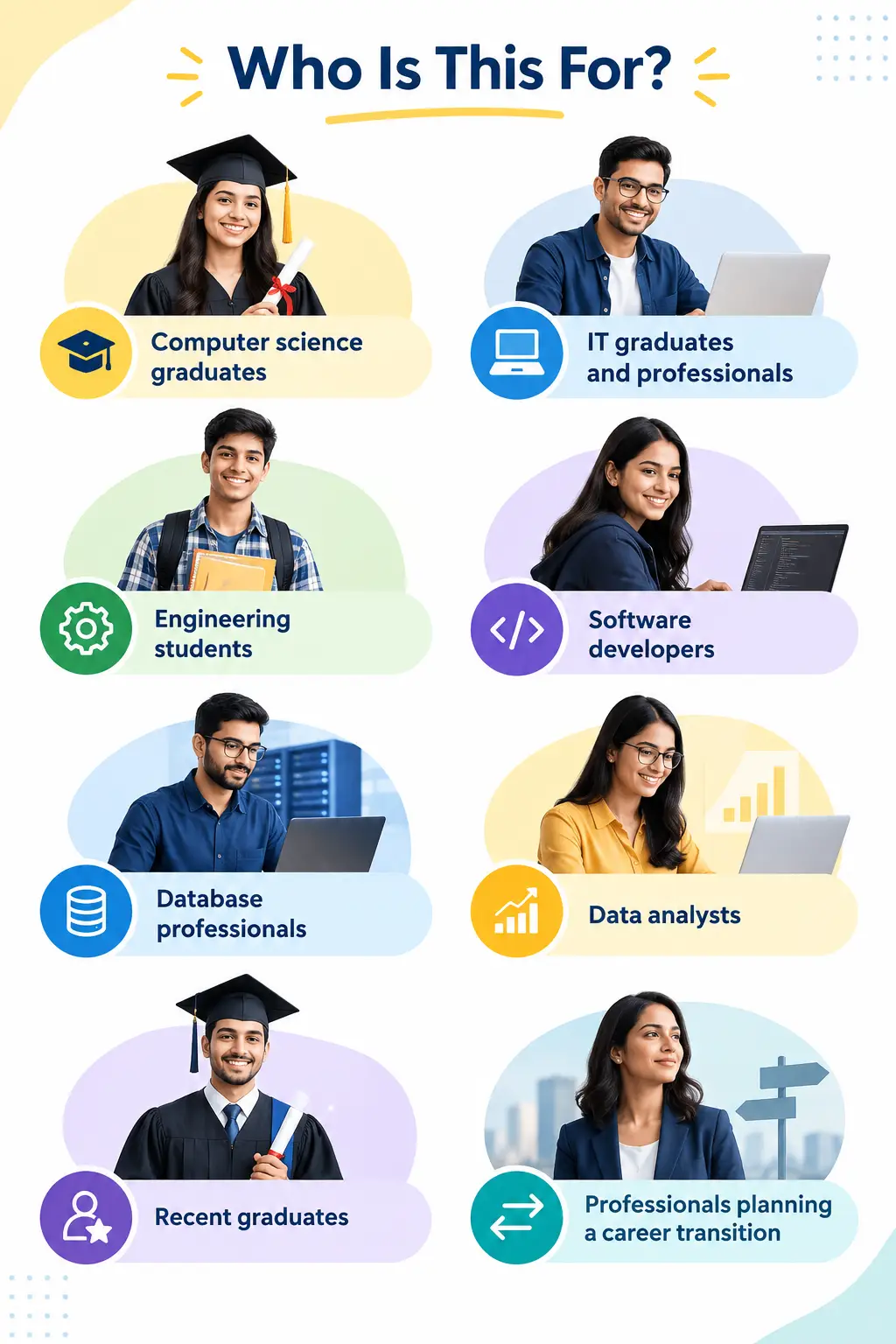
People with prior programming or database knowledge may find it easier to progress through advanced concepts, while beginners can build their foundation gradually through structured training.
How to Choose Data Engineering Training in Maharashtra?
When comparing Data Engineering Training in Maharashtra, learners should look beyond the course title and evaluate what the program actually teaches.
A useful curriculum should cover fundamental concepts before moving into advanced technologies. Look for training that includes SQL, Python, databases, ETL/ELT, data warehousing, data pipelines, cloud concepts, and practical projects.
Hands-on learning is particularly important in data engineering. Reading about pipelines or databases is different from actually designing a workflow, writing SQL queries, processing datasets, and troubleshooting errors.
Students should also consider trainer expertise, project exposure, course structure, learning format, assessments, and career guidance when selecting a program.
Career Opportunities in Data Engineering
Data engineering skills can be applied across technology, banking, financial services, healthcare, retail, manufacturing, logistics, telecommunications, e-commerce, and many other industries.
Depending on their skills and experience, learners may explore roles such as:
- Data Engineer
- Junior Data Engineer
- ETL Developer
- Data Pipeline Developer
- Database Developer
- Cloud Data Engineer
- Big Data Engineer
- Analytics Engineer
The exact responsibilities of these roles can vary between organizations. Some positions focus heavily on databases and ETL, while others involve cloud infrastructure, distributed processing, real-time data, or data platform development.
Why Practical Projects Matter
Data engineering is a technical field, so practical experience can be extremely valuable. Projects allow learners to apply concepts in a realistic environment.
For example, a project could involve collecting data from multiple sources, cleaning and transforming the information, storing it in a database or warehouse, and creating a pipeline that automatically updates the data.
Such exercises help learners understand not only individual technologies but also how different components work together as part of a complete data architecture.
Data Engineering Certification: What Should You Consider?
A Data Engineering Certification Course in Maharashtra can provide structured learning and demonstrate completion of a training program. However, certification should not be viewed as a replacement for practical knowledge.
When evaluating a certification program, learners should consider the curriculum, practical assignments, project work, assessment methodology, and technologies covered. Building technical skills alongside certification can provide a more useful foundation for professional development.
FAQs
1. Who should learn data engineering?
Data engineering can be suitable for IT professionals, software developers, engineering graduates, computer science students, data analysts, and learners interested in databases, cloud technologies, and data platforms.
2. Is programming required for data engineering?
Programming knowledge is useful because data engineers often work with Python, SQL, scripting, and data-processing technologies. Beginners can start with programming fundamentals and gradually develop more advanced skills.
3. What technologies are commonly included in data engineering?
Depending on the curriculum, learners may study SQL, Python, databases, ETL/ELT, data warehousing, data pipelines, Apache Spark, cloud platforms, and data integration technologies.
4. How do I choose a Data Engineering Institute in Maharashtra?
Compare the curriculum, practical projects, trainer expertise, technologies covered, learning format, assessments, and career support. A strong program should connect theoretical concepts with hands-on implementation.
5. Is data engineering related to data science?
Yes. Data engineering and data science are closely connected but have different primary responsibilities. Data engineers build and maintain systems that make reliable data available, while data scientists commonly use that data for analysis, modeling, and predictive solutions.
6. Does completing a data engineering course guarantee a job?
No course or certification can guarantee employment. Career opportunities depend on technical skills, practical experience, projects, educational background, communication skills, and interview performance.
Also Read: Full Stack Java Course in Maharashtra
Conclusion
Data engineering provides the technical foundation required to collect, process, organize, and deliver data for analytics and modern business applications. As organizations continue adopting cloud technologies, artificial intelligence, and data-driven systems, understanding databases, pipelines, ETL processes, data warehousing, and scalable data platforms can be valuable for technology professionals. For learners looking for a structured Data Engineering Course in Maharashtra, Bikkadit provides an opportunity to develop relevant concepts through a practical and structured learning approach, helping students build a stronger foundation for their data engineering journey.

